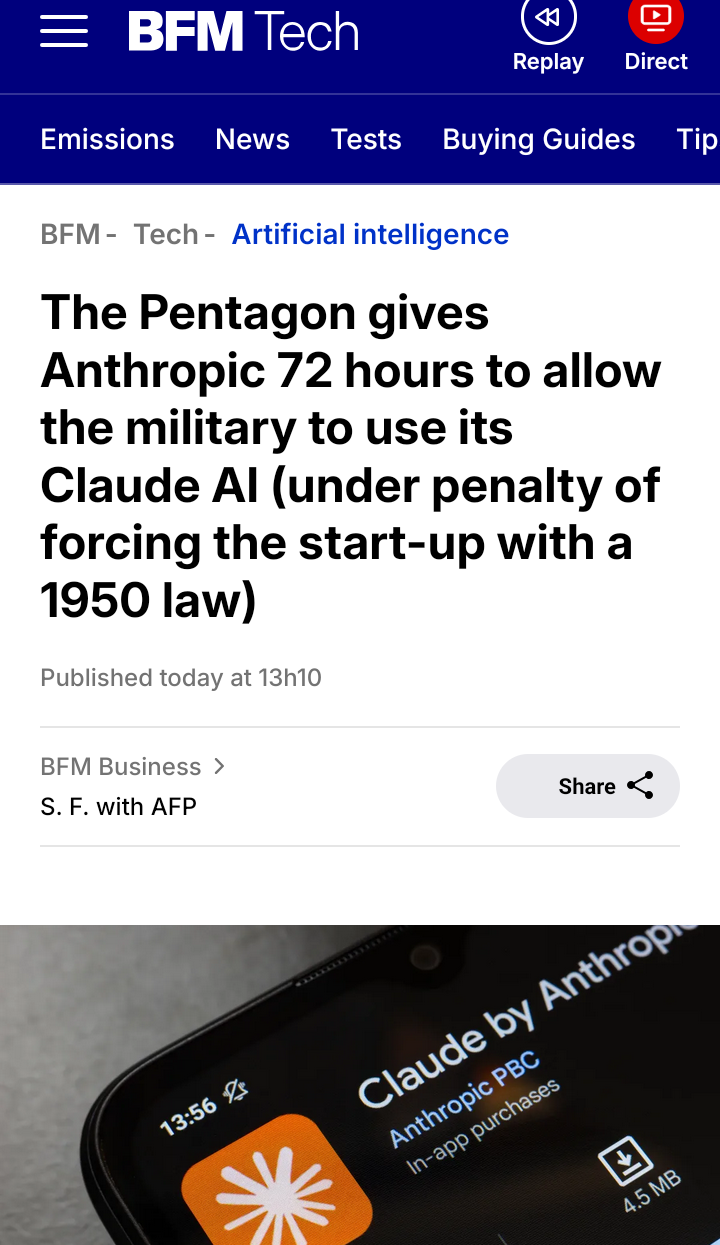
Anthropic vs. Pentagon: The Unfolding AI Ethics Battle Over Claude
The burgeoning field of artificial intelligence is not just about technological breakthroughs; it's increasingly about the profound ethical dilemmas that arise when advanced models intersect with sensitive applications like national defense. At the heart of one of the most significant current clashes is the standoff between Anthropic, a leading AI research company, and the U.S. Department of Defense (DoD), commonly known as the Pentagon. This isn't merely a contract negotiation; it's an existential debate over who controls the ethical guardrails of powerful AI, particularly when it comes to military use. The conflict, largely centered around Anthropic's sophisticated AI model, Claude, casts a long shadow over the future of ia militaire Pentagone strategies and the broader responsible development of artificial intelligence.
The High Stakes of the Claude-Pentagon Standoff
For Anthropic, a startup valued in the hundreds of billions, the dispute with the Pentagon extends far beyond the substantial $200 million contract on the table. This negotiation represents a critical juncture for the company's core identity and its commitment to "safe and responsible" AI. The battle has played out in the public eye, marked by direct quotes from unnamed Pentagon officials to the media, admonishing public statements, and intense social media discourse, reflecting the deep ideological chasm between the two entities.
At the center of this tension are key figures like Anthropic CEO Dario Amodei, a staunch advocate for ethical AI, and Defense Secretary Pete Hegseth, who, on behalf of the Pentagon, is pushing for comprehensive access to Claude. The stakes are immense: for Anthropic, it's about upholding its foundational principles; for the Pentagon, it's about securing cutting-edge technology crucial for maintaining a technological edge in an increasingly complex global landscape. The outcome could set a precedent for how other AI developers engage with government and military contracts globally.
Claude's Unprecedented Military Deployment and the Ethical Red Lines
The ethical debate intensified significantly following reports of Claude's deployment in a classified U.S. military operation against Nicolás Maduro, the former Venezuelan President. This operation, facilitated through a partnership with Palantir Technologies, marked a reported first: a major commercial AI model used in a highly sensitive military context. While the specifics remain undisclosed, this incident brought Anthropic's internal usage policies—which generally prohibit Claude from supporting violence, weapons development, or mass surveillance—into sharp relief. It highlighted the immediate, practical challenges of maintaining ethical boundaries when powerful AI tools are adopted by defense agencies.
Anthropic's commitment to responsible AI is codified in two non-negotiable "red lines" regarding Claude's military application:
- No Lethal Autonomous Weapons Systems: Claude must not be used in systems that operate without meaningful human control, especially concerning life-or-death decisions. The company emphasizes that current AI models, including Claude, are not reliable enough for such critical autonomy.
- No Mass Surveillance or Illegal Targeting: The AI model cannot be deployed for mass surveillance or any form of illegal targeting of individuals or groups, reinforcing privacy and human rights considerations.
These "red lines" are not just corporate policy; they are a direct challenge to the traditional military appetite for unrestricted technological leverage. Anthropic's stance underscores a growing sentiment within the AI community that creators bear a significant responsibility for how their innovations are ultimately used, particularly in sensitive sectors. This is a crucial aspect of Anthropic's Red Lines: Defining Responsible AI in Military Use, shaping the future dialogue around AI governance.
The Pentagon's Demands and the Imminent Deadline
The Pentagon, under Secretary Hegseth, has made its demands clear: unrestricted access to the Claude model for "any lawful" military use, coupled with the removal of Anthropic's self-imposed ethical safeguards. This push reflects a strategic imperative for the U.S. military to integrate advanced AI into all facets of its operations, from intelligence gathering and operational planning to strategic analysis. The pressure tactics employed by the DoD have been formidable, including explicit threats to terminate all existing government contracts with Anthropic and to blacklist the company and its partners from any future federal engagements if their demands are not met by a set deadline.
Dario Amodei, in a public statement, affirmed Anthropic's unwavering position, stating that recent Pentagon proposals "have made virtually no progress" on the company's crucial ethical points. "These threats do not change our position: we cannot in good conscience comply with their demands," he asserted. This resolute stance highlights the severe tension between national security imperatives and the ethical development of AI. The outcome of this standoff could drastically impact how the Pentagon, and indeed other global defense entities, approaches future partnerships with AI developers, potentially forcing a reevaluation of what constitutes acceptable usage of cutting-edge AI in defense.
Broader Implications: Navigating AI Ethics in National Security
The conflict between Anthropic and the Pentagon is a microcosm of a much larger global challenge: how to responsibly integrate powerful AI into national security frameworks. This debate sets a critical precedent, not only for Anthropic but for every AI company grappling with the "dual-use" nature of their technologies. Many AI innovations have the potential for immense societal benefit but also for profound harm, especially in military applications. This makes the discussion about ia militaire Pentagone and its ethical boundaries incredibly vital.
Practical Insights for the Future:
- Defining "Meaningful Human Control": A key takeaway from this conflict is the urgent need for clearer, internationally recognized definitions of "meaningful human control" in autonomous weapon systems. This involves not just technical limitations but also legal and ethical frameworks.
- Transparency in AI Procurement: Governments and defense agencies should consider greater transparency in their AI procurement processes, allowing for public discourse and ethical review, especially for models with broad societal impact.
- Incentivizing Ethical AI Development: Policy incentives could encourage AI companies to embed ethical considerations from the outset, rather than treating them as afterthoughts or optional add-ons.
- Collaborative Standard-Setting: Collaboration between governments, AI developers, ethicists, and civil society organizations is crucial to establish robust, adaptable ethical guidelines for military AI.
This ongoing ethical dilemma for the U.S. military is also explored in greater detail in Claude AI's Classified Military Use: Ethical Dilemmas for Pentagon. The Anthropic-Pentagon saga underscores that while the allure of advanced AI for defense is undeniable, ignoring the ethical implications comes with potentially devastating consequences. The challenge lies in finding a balanced path that harnesses AI's capabilities for national security without compromising fundamental ethical principles or contributing to an unchecked proliferation of autonomous warfare capabilities.
Conclusion
The showdown between Anthropic and the Pentagon over Claude is more than a commercial dispute; it's a defining moment in the nascent history of AI ethics. Anthropic's unwavering stance against unrestricted military use highlights the profound responsibility of AI developers to control how their creations are deployed. As the Pentagon seeks to leverage cutting-edge AI for its strategic objectives, the necessity of clear, ethically grounded boundaries becomes increasingly apparent. The resolution of this specific conflict, and the broader dialogue it represents, will significantly shape the future trajectory of AI development, setting precedents for responsible innovation and the integration of artificial intelligence into critical global systems, including defense.